
Silk Road Heritage
Bukhara
City of Infinite Wisdom · 2 landmarks
Map of Bukhara
2 landmarksAll Landmarks

Ark Fortress
Two thousand years of rulers walked these walls — until the Bolshevik bombardment of 1920. Ark of Bukhara is the oldest and most important historical monument in Bukhara, Uzbekistan. It is a huge ancient fortress that served as the residence of the rulers of Bukhara for many centuries. More than just a military fort, it was the political, administrative, and cultural centre of the city. Today, it is one of Uzbekistan's most famous tourist attractions and a symbol of Bukhara's rich history. The origins of the Ark date back to around the 5th century CE, although archaeological evidence suggests that people lived on this site even earlier. Over the centuries, the fortress was rebuilt and expanded many times because of wars, invasions, and natural damage. The structure seen today mainly took shape during the 16th century under the Shaybanid dynasty, with additional buildings added in later centuries. The fortress stands on a large artificial hill about 20 metres high and covers approximately 4 hectares. Its thick mud-brick walls and massive entrance towers made it one of the strongest defensive structures in Central Asia. From the top of the walls, guards could watch over the surrounding area and protect the city from enemy attacks. The Ark was often described as a "city within a city." At its peak, it contained royal palaces, government offices, a treasury, soldiers' barracks, workshops, warehouses, a mosque, stables, libraries, and even a prison. Thousands of people, including the Emir, his family, government officials, servants, guards, and craftsmen, lived and worked inside the fortress. This made the Ark the heart of political and social life in Bukhara. According to a famous legend, the fortress was founded by the Persian prince Siyavush. The story says that King Afrasiab agreed to let Siyavush marry his daughter only if he could build a palace on land covered by the skin of one bull. Siyavush cleverly cut the bull's skin into thin strips, stretched them into a large circle, and built the first fortress within it. Although this is a legend rather than a historical fact, it remains an important part of Bukhara's cultural heritage. Throughout its history, the Ark survived many invasions. It was attacked by Arab armies, damaged during the Mongol invasion led by Genghis Khan, and rebuilt several times by different rulers. The fortress remained the official residence of the Emirs of Bukhara until 1920, when the Red Army captured Bukhara. Heavy bombardment caused severe damage to many of the buildings inside the fortress, leaving much of it in ruins. Today, the Ark has been partly restored and functions as a museum complex. Visitors can explore exhibitions about the history of Bukhara, traditional crafts, weapons, clothing, manuscripts, and the lives of the Emirs. They can also visit the coronation court, mosque, throne hall, and enjoy panoramic views of the old city from the fortress walls. The Ark of Bukhara is also recognised as part of the historic centre of Bukhara, which is included on the UNESCO World Heritage List. It represents more than 1,500 years of history and reflects the importance of Bukhara as a major centre on the Silk Road, where traders, scholars, and travellers from different cultures met and exchanged ideas. In conclusion, the Ark Fortress is not only the oldest building in Bukhara but also one of the most significant historical monuments in Central Asia. It symbolises the political power, cultural achievements, and architectural heritage of ancient Bukhara. Visiting the Ark offers a unique opportunity to experience the history of the Silk Road and understand how rulers governed one of the region's greatest cities over many centuries.
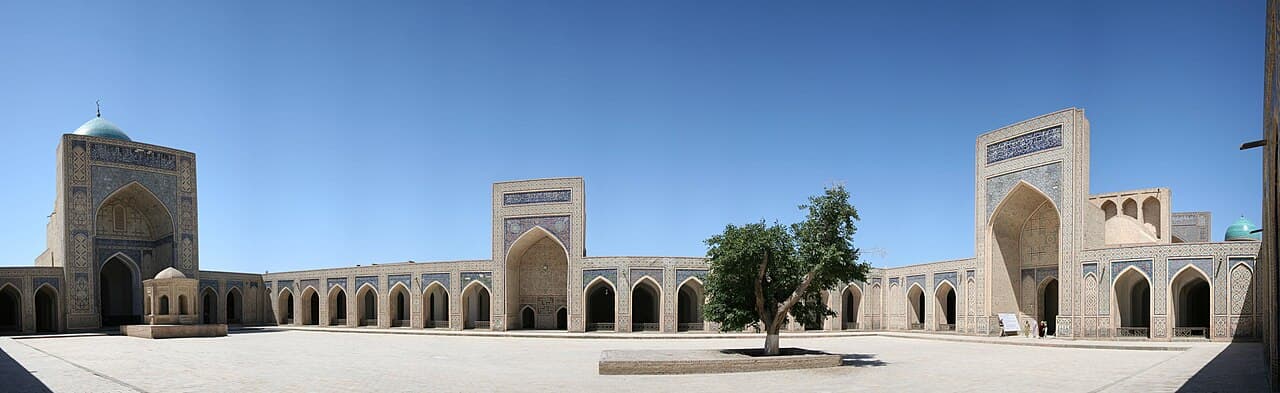
Po-i-Kalyan Complex
The Kalyan Minaret, mosque, and Mir-i-Arab madrasa form Bukhara's spiritual heart.